


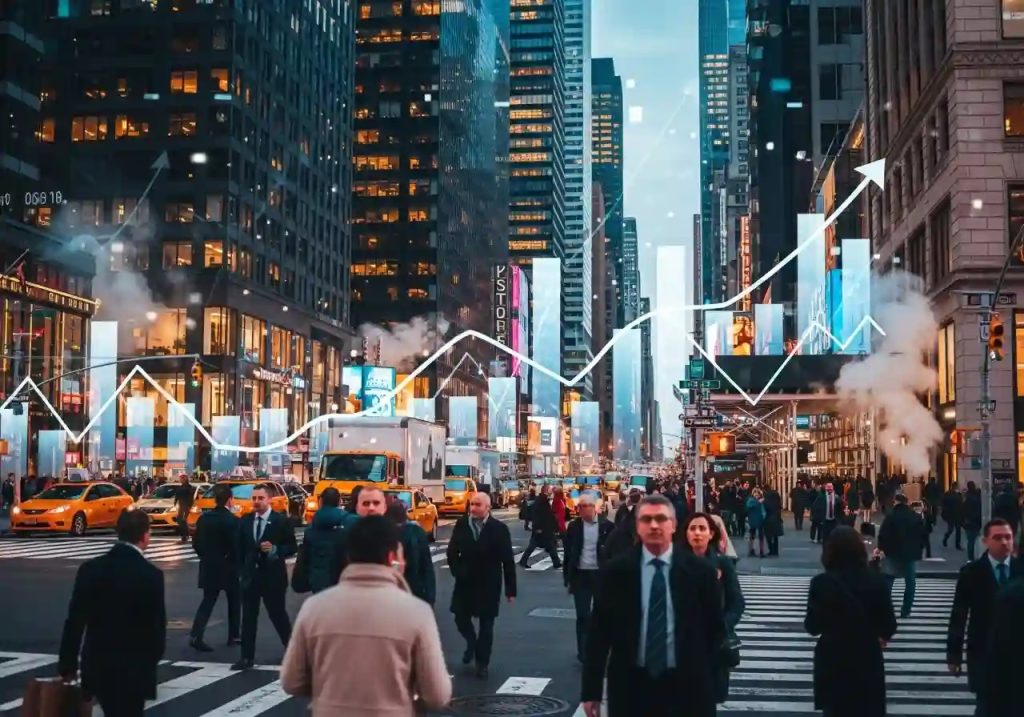
The U.S. economy grew at a surprisingly strong annual rate of 4.3% in the third quarter, marking its fastest pace in two years, driven by consumers who continue to spend despite persistent inflation.
The U.S. Department of Commerce said in a report released on Tuesday—delayed due to the government shutdown—that U.S. gross domestic product (GDP), the total output of goods and services, rose from a 3.8% growth rate in the second quarter (April–June) to July–September.
According to the Associated Press, economists surveyed by the data firm FactSet had expected growth of just 3% during the period.
Consumers Remain the Main Engine
As has been the case for most of the year, consumers were the primary driver of the U.S. economy. Consumer spending, which accounts for roughly 70% of economic activity, rose at an annual rate of 3.5% in the third quarter, up from 2.5% in the April–June period.
However, many economists believe the growth surge could be short-lived. A prolonged government shutdown may weigh on the economy in the final quarter of the year, while growing numbers of Americans are becoming increasingly frustrated with stubbornly high inflation.
A survey released Tuesday by the Conference Board showed consumer confidence falling to levels not seen since the United States imposed sweeping tariffs on trading partners in April.
The survey indicated that consumer confidence weakened in December as Americans grew more concerned about rising prices and the impact of broad tariffs imposed by President Donald Trump.
The Conference Board said its Consumer Confidence Index fell 3.8 points to 89.1 in December, marking a fifth consecutive monthly decline and nearing April’s reading of 85.7, which followed Trump’s imposition of import taxes. November’s reading was revised upward to 92.9.


The “K-Shaped” Economy
Stephen Stanley, chief U.S. economist at Santander Bank, said:
“The sharp increase in consumer spending reminds me a lot of the final quarter of last year. Consumers were overspending. As was the case at the beginning of this year, households will likely need a breather soon.”
The apparent divergence between what consumers say they feel and how much they continue to spend provides further evidence of what economists call a “K-shaped economy.” In this scenario, wealthier Americans benefit from stock market gains and rising investments, while lower-income households struggle with stagnant wages and higher prices.
Michael Pearce, chief U.S. economist at Oxford Economics, wrote:
“The latest household spending data point to continued strong gains in consumer spending, especially on services. We believe this reflects an uneven consumer recovery, led by older and wealthier households, while lower- and middle-income families remain under pressure.”
Inflation Remains Elevated
Tuesday’s GDP report showed that inflation remains higher than the Federal Reserve would prefer. The Fed’s preferred inflation gauge—the Personal Consumption Expenditures (PCE) index—rose to an annual rate of 2.8% in the third quarter, up from 2.1% in the second quarter.
Excluding volatile food and energy prices, core PCE inflation increased to 2.9%, up from 2.6% in the April–June period.
Economists say persistent—and potentially rising—inflation could make a January interest-rate cut less likely, even as Federal Reserve officials remain concerned about a slowing labor market.
“If the economy continues to operate at this level, there’s little reason to worry about an economic slowdown,” said Chris Zaccarelli, chief investment officer at Northlight Asset Management, adding that inflation could once again become the economy’s biggest threat.

Another Key Growth Driver
The latest data also highlighted another steady engine of the U.S. economy: investment in artificial intelligence. Investment in intellectual property, which includes AI, grew 5.4% in the third quarter, following a larger 15% surge in the second quarter and 6.5% growth in the first quarter.
Government spending and investment rose 2.2% in the third quarter, after contracting 0.1% in the second quarter, supported by increased state and local spending as well as federal defense outlays.
Private business investment fell 0.3%, driven by declines in housing and non-residential construction such as offices and warehouses. Still, this drop was far smaller than the 13.8% plunge in the second quarter.
Within the GDP data, a measure of the economy’s underlying strength grew at an annual rate of 3%, slightly above 2.9% in the second quarter. This metric includes consumer spending and private investment but excludes volatile components such as exports, inventories, and government spending.
Exports rose 8.8%, while imports—which subtract from GDP—fell another 4.7%. Tuesday’s report represents the first of three government estimates for third-quarter GDP growth.